![]() |
![]() |
![]() |
|
|
Starry Night This Week How to See Something 20,000 Times The Size Of Our Solar System With Just The Naked Eye
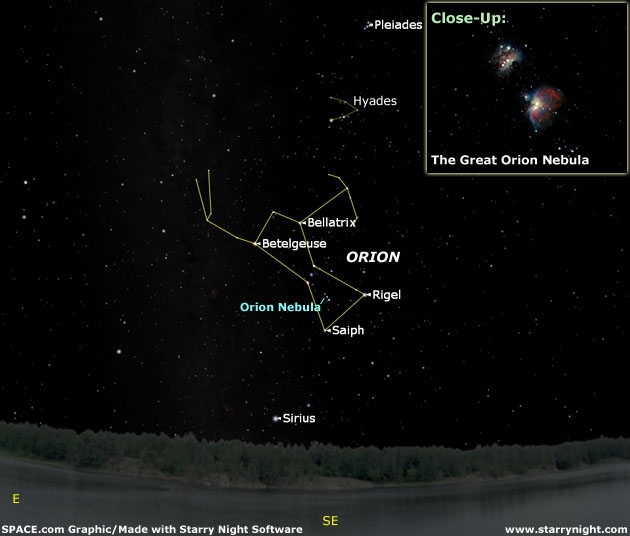
Easily visible to the naked eye as a fuzzy patch in the middle of Orion’s sword. What we call the Orion Nebula is just the central part of a larger cloud that stretches across several hundred light years. Four bright stars in a parallogram near the nebula’s centre form the Trapezium. These hot young stars heat up the surrounding gas clouds, causing the nebula to emit light. This view shows the sky on the week of January 13th at 9:00 PM, as seen from mid-northern latitudes. Still want to know more? Click here for an archive of the past shows. Introduce yourself to the wonders of the night sky with Starry Night Backyard. Astronomy software so realistic and easy to use that learning your way around the night sky has never been easier. Learn how to identify planets, stars and constellations. View the heavens from your own backyard or anyplace on Earth. Blast-off and explore the solar system, ride a comet or check out the view from the International Space Station. Do it all using Starry Night Backyard. And for those whose interest in the night sky goes even deeper, you'll want to get the new advanced Starry Night Pro. With extended data sets, dozens of new Pro-only features and Internet support not found in any other program you'll wonder how you ever observed without it! See the wonders of our Universe in all its three-dimensional glory. Pilot a starship through 700 million light years of space and 30,000 galaxies. See what's really out there, with Deep Space Explorer. Feel free to send us an email if you have any questions about Starry Night that you can't find answered here on our website. We also welcome your feedback and suggestions. |
|||||||||||||||||||
|